The Indian flute carries a sound that is at once simple, sacred and technically demanding. In mythology, the bansuri is inseparable from Lord Krishna, while bamboo flutes have long belonged to pastoral, folk and devotional traditions across the subcontinent. In North Indian classical music, the transverse bansuri became a major solo instrument; in South India, the venu developed a distinct Carnatic voice shaped by gamakas, rhythmic precision and vocal-style phrasing.
That transformation took generations. Pioneers redesigned instruments, expanded their range and proved that bamboo could sustain a full raga recital with alap, taans, meend and complex laya. Later artists carried the flute into global festivals, fusion, cinema and conservatories without losing its classical core.
1. Pandit Hariprasad Chaurasia
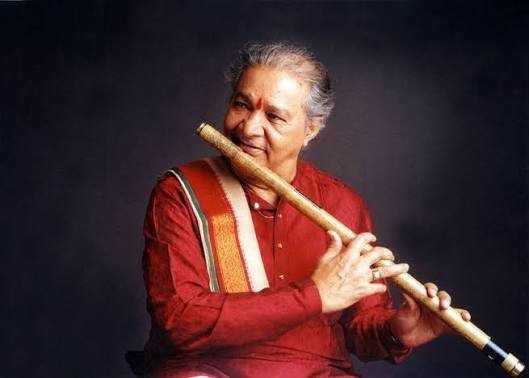
Pandit Hariprasad Chaurasia is the most internationally recognised living exponent of the Hindustani bansuri. After early training with Pandit Bholanath, he studied under Annapurna Devi of the Maihar tradition. His playing is admired for a warm tone, long meend, controlled breath, meditative alap and brilliant rhythmic passages. He also expanded the flute’s reach through world tours, film composition and teaching.
Key highlights:
- Sangeet Natak Akademi Award in 1983 and Fellowship in 2011.
- Padma Bhushan in 1992 and Padma Vibhushan in 2000.
- Co-created major film scores with Shivkumar Sharma as Shiv-Hari.
- Founded Vrindaban Gurukul to train younger flautists.
2. Pandit Pannalal Ghosh
Pandit Pannalal Ghosh made the modern Hindustani concert bansuri possible. He enlarged the bamboo flute, developed a lower-pitched instrument and introduced a seventh finger hole, improving its range and suitability for serious raga music. His association with Ustad Allauddin Khan linked him to the Maihar tradition. He proved that the flute could handle weighty ragas, extended alap and complex classical architecture rather than remaining mainly a folk instrument.
Key highlights:
- Widely regarded as a father of the modern classical bansuri.
- Developed a roughly 32-inch seven-hole concert flute and a special bass flute.
- Served as music director of All India Radio’s National Orchestra.
- Established a classical vocabulary later bansuri players expanded.
3. Dr. N. Ramani
Dr. N. Ramani was one of the great architects of the modern Carnatic flute tradition. A disciple of T. R. Mahalingam, or “Flute Mali,” Ramani refined a vocalised style in which the venu reproduced the curves and gamakas of Carnatic singing. He also popularised longer, lower-register flutes and brought greater rhythmic sophistication to flute concerts, while retaining a lyrical tone in fast swara passages.
Key highlights:
- Sangeet Natak Akademi Award in 1984.
- Padma Shri recipient and Sangeetha Kalanidhi in 1996.
- Helped bring the long bass flute into Carnatic performance.
- Trained many disciples through Ramani’s Academy of Flute.
4. Shashank Subramanyam
Shashank Subramanyam represents the technically adventurous side of contemporary Carnatic flute. A child prodigy who began performing at six, he developed a style combining Carnatic vocal imagination with advanced fingering and breath control. His innovations include multi-flute transposed fingering, claw-shaped fingering, fast taans, smooth register changes and dual-octave effects. His Ragam-Tanam-Pallavi presentations are especially known for rhythmic complexity.
Key highlights:
- Sangeet Natak Akademi Award for 2017.
- Kalaimamani honour from Tamil Nadu.
- Chevalier de l’Ordre des Arts et des Lettres, France, in 2022.
- Known for gamakas, octave control and multi-flute technique.
5. Pandit Ronu Majumdar
Pandit Ronu Majumdar combines Hindustani raga depth with an openness to contemporary collaboration. He trained with his father, Pandit Lakshman Prasad Jaipurwale and Pandit Vijay Raghav Rao, and also received guidance from Ravi Shankar. Associated with the Maihar stream, Majumdar is known for sonorous tone, carefully shaped alap and agile taans. His career also reaches into cinema and world music.
Key highlights:
- Sangeet Natak Akademi Award for 2014.
- Worked on Ravi Shankar’s “Chants of India.”
- Composed music for the IMAX film “Mystic India.”
- Collaborated widely across classical, film and world music.
6. Rakesh Chaurasia
Rakesh Chaurasia is one of the strongest contemporary carriers of the Hariprasad Chaurasia tradition. As his nephew and disciple, he inherited an approach built on lyrical meend, sustained tone and patient raga development, while developing his own identity through global collaborations. His ability to move between intimate Hindustani recitals and large international ensembles has given the bansuri strong visibility among younger audiences.
Key highlights:
- Disciple and nephew of Pandit Hariprasad Chaurasia.
- Won two Grammy Awards in 2024 with Béla Fleck, Zakir Hussain and Edgar Meyer projects.
- Performs classical, fusion and cross-cultural repertoire.
- A major Indian flautist on the international stage.
7. Pandit Vijay Raghav Rao
Pandit Vijay Raghav Rao had an unusually broad artistic life as flautist, composer, choreographer and film-music creator. After early dance training, he turned seriously to classical music following his association with Ravi Shankar. He became an All India Radio soloist and composer and later served as Director of Music in the Films Division. His flute style combined precision with a strong compositional mind.
Key highlights:
- Padma Shri in 1970.
- Sangeet Natak Akademi Award for Creative Music in 1982.
- Worked extensively with All India Radio and Films Division.
- Influenced later flautists, including Ronu Majumdar.
8. Pravin Godkhindi
Pandit Pravin Godkhindi is a major modern Hindustani bansuri artist from Karnataka. Trained by his father, Pandit Venkatesh Godkhindi, he absorbed Kirana gharana gayaki while also cultivating gatkari or tantrakari-style fluency. His playing combines breath control, layakari, a sonorous tone and fast instrumental passages. He has also explored jazz, Carnatic music and fusion. He is especially known for performing on an eight-foot contrabass flute.
Key highlights:
- A Top-ranking Hindustani bansuri artist of All India Radio.
- First Indian to represent bansuri at the World Flute Festival in Mendoza.
- First Indian documented to perform Indian classical music on an eight-foot contrabass flute.
- Received the Krishna Hangal National Award in 2026.
Naveen Kumar occupies a different but highly influential space: Indian cinema. A versatile flautist and studio musician, he has worked extensively with A. R. Rahman and other leading composers. His playing features in memorable film passages, including the celebrated “Bombay Theme.” Naveen also experimented with instrument design, creating the “Naveen Flute,” which combines flute tone with sympathetic string vibration.
Key highlights:
- Long-time collaborator with A. R. Rahman.
- Known for landmark flute work in Indian film music.
- Created the string-enhanced “Naveen Flute.”
- Worked across Bollywood, South Indian cinema and fusion.
10. Debopriya and Suchismita Chatterjee – The Flute Sisters
Debopriya and Suchismita Chatterjee, known as the Flute Sisters, have created a distinctive place in Hindustani music as a rare female bansuri duet. They received early training from Pandit Bholanath Prasanna and later became disciples of Hariprasad Chaurasia. Their duet format demands close tonal matching, synchronised meend and coordinated improvisation, while their visibility has challenged the traditionally male image of the concert bansuri.
Key highlights:
- Disciples of Pandit Hariprasad Chaurasia.
- Studied Indian and Western music, including in Rotterdam.
- Debopriya received the Ustad Bismillah Khan Yuva Puraskar for 2008.
- Perform at major classical festivals in India and abroad.
Conclusion
India’s flute tradition is a story of continuity through invention. Pannalal Ghosh redesigned the Hindustani instrument, N. Ramani expanded the Carnatic venu, and Hariprasad Chaurasia gave the bansuri global recognition. Shashank, Rakesh Chaurasia, Ronu Majumdar and Pravin Godkhindi continue to stretch its technical and stylistic reach, while Naveen Kumar and the Flute Sisters show how widely the instrument’s identity can expand.
Beyond 2026, Indian flute music will continue crossing genres and borders. Yet its deepest appeal remains unchanged: breath passing through bamboo and becoming raga, prayer, memory and emotion.