The guitar entered Indian popular music largely as a Western accompaniment instrument, but Indian musicians gradually reshaped it into something far more versatile. In film studios it supplied bluesy fills, rock riffs and acoustic textures. In independent music it powered progressive rock, jazz and blues. Most remarkably, players such as R. Prasanna and Baiju Dharmajan showed that Carnatic gamakas, meend-like slides and complex tala ideas could be translated convincingly onto fretted electric guitars.
That evolution produced guitarists with distinctive voices rather than borrowed styles. Some built careers around instrumental tone; others changed Indian film music or created new fusion languages from raga, folk, jazz and rock. This 2026 list considers influence, musicianship, originality, body of work and continuing relevance.
1. R. Prasanna
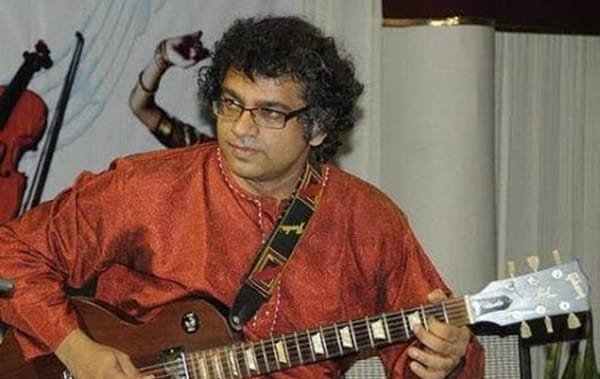
Prasanna, widely known as Guitar Prasanna, is the defining pioneer of Carnatic music on the standard electric guitar. Trained by vocalist Tiruvarur Balasubramaniam and violinist A. Kanyakumari, he developed slides, slurs, hammer-ons and pull-offs to reproduce gamaka without depending on a specially modified instrument.
A Berklee graduate, Prasanna moves between Carnatic raga, jazz, progressive rock, blues and film scoring. His work includes Tirtha with Vijay Iyer and Nitin Mitta, collaborations with A. R. Rahman, and the score for the Oscar-winning documentary Smile Pinki. He proved that a fretted guitar can articulate serious Carnatic phrasing while retaining its electric identity.
2. Baiju Dharmajan
Baiju Dharmajan is one of the main architects of Carnatic-inflected Indian rock. The Kochi guitarist became central to Motherjane’s sound through raga-based phrases, sustained bends and soaring progressive-rock solos. His playing on Maktub helped Indian rock sound rooted locally rather than copied from Western hard rock.
After years away, Dharmajan returned as Motherjane’s lead guitarist, and the reunited band entered another phase with the 2026 album Dobareh. Fans call him the “God of Small Strings,” a nickname acknowledged by the band. His signature remains the meeting of Carnatic melodic thinking with high-gain electric tone.
3. Ehsaan Noorani
Ehsaan Noorani helped make electric guitar a natural part of modern Hindi film composition. A member of Shankar-Ehsaan-Loy, he trained at the Guitar Institute of Technology in Hollywood and built his vocabulary from blues, rock, pop and studio session work.
Noorani’s strength is not flashy virtuosity for its own sake. He excels at hooks, chord colours, blues phrasing and textures that support a song. That sensibility shaped albums such as Dil Chahta Hai, Kal Ho Naa Ho and Rock On!!. He has also had a signature Squier Stratocaster model, reinforcing his influence on Indian guitar learners.
4. Amyt Datta
Kolkata’s Amyt Datta is a guitarist’s guitarist, admired for harmony, improvisation and uncompromising curiosity. His career has included Shiva, Skinny Alley, Pinknoise and experimental projects, while his teaching has shaped generations of players in eastern India.
Datta’s language moves through jazz harmony, progressive rock, blues, odd metres and abstract improvisation. Dense chord extensions and unusual melodic ideas rarely sound academic in his hands. In 2026, after more than five decades of playing, he remains active on Kolkata stages. His legacy is proof that Indian rock guitar can be intellectually adventurous without losing spontaneity or emotion.
5. Warren Mendonsa (Blackstratblues)
Warren Mendonsa built Blackstratblues around a demanding idea: let the guitar do the singing. The Mumbai-born, Auckland-based musician favours melodic phrasing, expressive vibrato, controlled gain and Stratocaster clarity over empty displays of speed.
His background includes the influential band Zero, but Blackstratblues became his defining project. In 2026, Mendonsa released Artificial Integrity and returned to Indian stages, including the Mahindra Blues Festival. His playing draws from blues-rock and instrumental rock, yet restraint is central to his sound. Bends resolve naturally, notes breathe, and tone becomes part of the composition itself.
6. Susmit Sen
Susmit Sen co-founded Indian Ocean in 1990 and helped establish one of the most original guitar languages in Indian independent music. Largely self-taught, he built phrases around open strings, modal scales and repeating melodic cells instead of conventional rock chord progressions.
That method allowed Hindustani and folk-inspired ideas to coexist with jazz and rock rhythm sections. Sen’s acoustic sound became fundamental to Indian Ocean and later continued through the Susmit Sen Chronicles and solo work. His influence is especially important because he proved that Indian acoustic guitar could sound indigenous without simply imitating the sitar or sarod.
7. Dhruv Ghanekar
Dhruv Ghanekar is as much a composer-producer as a guitarist. His work moves across jazz fusion, Indian folk, funk, rock, film scoring and large-scale productions. As a player, he combines modern chord voicings, rhythmic displacement and fluid electric leads with a producer’s ear for arrangement.
Ghanekar co-founded Mumbai’s influential blueFrog venue and has worked with Richard Bona, Trilok Gurtu, Raul Midón and A. R. Rahman. His Voyage projects place Indian folk voices alongside African grooves and jazz harmony. Few Indian guitarists connect live improvisation, studio craft and global fusion as naturally.
8. Bruce Lee Mani
Bruce Lee Mani is the guitarist, singer and songwriting force behind Bengaluru rock institution Thermal and a Quarter. His style moves between blues phrasing, jazz-informed chords, progressive structures and classic-rock riffing.
Mani is not primarily a shred player. His strength lies in shaping songs through chord movement, melodic fills and solos that respond to lyric and groove. A two-time Rolling Stone India Guitar Player of the Year, he is also an educator through Taaqademy. In 2026, Thermal and a Quarter entered its 30th year with anniversary concerts and new material, underlining his durability in Indian indie rock.
9. Keba Jeremiah
Keba Jeremiah is one of the most versatile session guitarists to emerge from Chennai’s film-music ecosystem. Comfortable on acoustic and electric guitar, he has worked with A. R. Rahman, Harris Jayaraj, Yuvan Shankar Raja and Anirudh Ravichander across Tamil, Hindi and Telugu cinema.
Jeremiah’s studio value comes from adaptability. He can provide fingerstyle acoustic lines, clean arpeggios, ambient textures or precise lead parts without crowding an arrangement. His credits include major soundtracks such as Rockstar, Raanjhanaa and Kadal. His career shows how technique, versatility and disciplined session musicianship can be as influential as fronting a famous band.
10. Rudy Wallang
Shillong guitarist Rudy Wallang is a foundational figure of the Indian blues movement. As co-founder, guitarist, songwriter and vocalist of Soulmate, he helped take blues from the North-East to major festivals and clubs across India and overseas.
Wallang’s lead playing is rooted in pentatonic blues, but phrasing is his real strength. He uses bends, vibrato, space and call-and-response lines to make solos feel vocal. Soulmate disbanded after its 2022 tour, but Wallang continued writing and performing. In 2026, he was active with a new outfit and new material, showing that his commitment to old-school blues remains alive.
Conclusion
These ten guitarists show how widely the instrument has travelled in Indian music. Prasanna and Baiju Dharmajan translated Carnatic ideas into electric language; Susmit Sen developed an Indian acoustic vocabulary; Ehsaan Noorani and Keba Jeremiah reshaped film guitar; while Amyt Datta, Dhruv Ghanekar, Bruce Lee Mani, Warren Mendonsa and Rudy Wallang expanded rock, jazz and blues possibilities.
Beyond 2026, Indian guitar will keep evolving through the same balance: respect for raga, tala and folk memory combined with fearless use of amplification, pedalboards, studio technology and global harmony.