Sorghum is one of India’s most versatile dryland crops. Its grain becomes jowar roti, bhakri, porridge, snacks and flour, while the stalks are valuable cattle fodder. Sweet sorghum can supply juice and ethanol, and forage types provide repeated green cuts. Known as jowar in Hindi, jwari in Marathi, jola in Kannada, cholam in Tamil and janha in Odia, the crop remains especially important where rainfall is uncertain.
By 2026, choosing sorghum is no longer simply about grain yield. ICAR-IIMR recommendations cover early kharif hybrids, rainfed dual-purpose types, rabi grain sorghum, low-lignin fodder and sweet sorghum for biofuel. Breeding is also targeting grain-mould resistance, drought resilience and better fodder digestibility. Several leading cultivars are hybrids, so “varieties” is used here in the broad farmer-and-market sense. So, let’s check out the top 10 sorghum varieties in India!
1. CSH 48
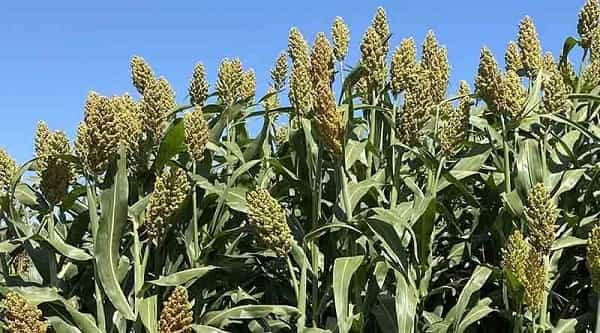
CSH 48 is one of the strongest newer kharif sorghum hybrids for 2026. ICAR-IIMR released it as an early grain hybrid after multi-year testing showed a clear yield advantage over CSH 30.
- Recommended belt: Karnataka, Tamil Nadu, Telangana, Madhya Pradesh, Gujarat and Rajasthan.
- Maturity & yield: Early kharif hybrid; about 3.88 t/ha mean grain yield in three years of AICRP testing.
- Yield advantage: Roughly 8.2% higher grain yield than CSH 30.
- Best fit: Rainfed kharif farms needing early maturity and good grain production.
2. CSV 50 Red
CSV 50 is a specialty red-grain sorghum combining good yield with grain-mould tolerance. ICAR-IIMR also found better protein, iron, zinc and antioxidant activity than the white-grain check CSV 20.
- Recommended belt: Karnataka, Telangana and Maharashtra.
- Maturity & grain type: Medium-maturing specialty sorghum with red grain.
- Yield: Mean grain yield around 4.12 t/ha.
- Quality strength: Improved grain-mould tolerance and stronger nutritional traits than CSV 20.
- Best uses: Food products, feed, baking blends and specialty red-grain markets.
3. CSH 45 (Jaicar Varsha)
Jaicar Varsha is an early kharif hybrid developed for rainfed sorghum regions. Its balance of grain and fodder is useful where farmers need both marketable jowar and livestock feed.
- Recommended belt: Karnataka, Maharashtra, Rajasthan and Telangana under rainfed conditions.
- Maturity: About 105 days.
- Yield profile: Around 44.5 q/ha grain and 121.4 q/ha fodder.
- Best fit: Rainfed farms seeking an early grain-plus-fodder hybrid.
4. CSH 41 (Jaicar Gold)
CSH 41 remains one of India’s leading high-yielding kharif sorghum hybrids. ICAR-IIMR’s current farmer advisory lists it across major sorghum states and as the all-India kharif hybrid recommendation.
- Recommended belt: Madhya Pradesh, Rajasthan, Gujarat, Maharashtra, Karnataka, Andhra Pradesh, Telangana and Tamil Nadu.
- Maturity & yield: Around 105 days; roughly 47 q/ha grain and 124 q/ha fodder.
- Plant type: High-yielding dwarf kharif hybrid.
- Stress strength: Release descriptions highlight resistance to important pests and diseases.
5. CSV 41
CSV 41 is a dependable open-pollinated kharif grain variety for farmers who prefer a variety rather than a hybrid. It performs under rainfed conditions across both higher- and lower-fertility soils.
- Recommended belt: Andhra Pradesh, Telangana, Tamil Nadu, Rajasthan and Gujarat; also listed among current all-India kharif varieties.
- Maturity & yield: About 106-110 days; around 31.8 q/ha grain and 160 q/ha fodder.
- Grain quality: Protein content about 9.72%.
- Stress strength: Moderately tolerant to grain mould, shoot fly and stem borer.
6. CSV 27
CSV 27 is a strong dual-purpose sorghum because it keeps green foliage up to maturity while producing useful grain. Its non-senescent, non-lodging habit makes the stover especially valuable on mixed crop-livestock farms.
- Recommended belt: All sorghum-growing areas under rainfed conditions.
- Maturity & yield: About 117 days; around 28-29 q/ha grain and 190-200 q/ha fodder.
- Agronomic strength: Non-senescent, non-lodging and tolerant to grain mould.
- Best fit: Farms where grain and large quantities of fodder are both important.
7. CSV 29R
CSV 29R is an important post-rainy or rabi sorghum for the Deccan. Rabi sorghum relies heavily on stored soil moisture, so drought adaptation, roti quality and stalk value become especially important.
- Recommended belt: Maharashtra, Karnataka and Andhra Pradesh, with wider rabi recommendations in other states.
- Maturity & yield: About 118 days; around 25.5 q/ha grain and 67.9 q/ha fodder.
- Stress strength: Charcoal-rot resistant and tolerant to shoot fly.
- Best fit: Rabi systems where food grain and dependable stover are both valued.
8. CSV 43 BMR (Jaicar Nutrigraze)
CSV 43 BMR is India’s first brown-midrib sorghum variety and a major advance in fodder quality. Its lower lignin improves digestibility, so it is designed for livestock performance rather than simply maximum stalk bulk.
- Recommended belt: Telangana, Andhra Pradesh, Karnataka, Maharashtra, Tamil Nadu, Gujarat, Madhya Pradesh, Rajasthan, Uttar Pradesh, Uttarakhand, Haryana and Jharkhand.
- Maturity & yield: 70-75 days for green fodder and 110-112 days for stover; around 21-23 q/ha grain and 155-160 q/ha dry fodder.
- Fodder quality: Low lignin and high digestibility.
- Best fit: Dairy and livestock farms prioritising nutritious fodder.
9. CSH 24MF
CSH 24MF is a proven multi-cut forage sorghum hybrid and remains commercially active in 2026. ICAR-IIMR continued licensing it to seed companies during 2024-25, reflecting strong demand in fodder systems.
- Recommended belt: Uttarakhand, Uttar Pradesh, Gujarat, Haryana, Punjab and Delhi.
- Forage yield: Around 914 q/ha green fodder and 232 q/ha dry fodder.
- Crop habit: Tall plants with thick juicy stems and good regrowth after cutting.
- 2026 relevance: Still being licensed commercially by ICAR-IIMR.
- Best fit: Dairy farms needing repeated high-volume green fodder.
10. CSV 49SS (Jaicar Raseela)
CSV 49SS represents the sweet-sorghum side of Indian jowar breeding. Instead of focusing mainly on grain, it produces sweet juicy stalks suited to syrup, bioethanol and integrated grain-plus-biomass value chains.
- Recommended belt: Maharashtra, Telangana, Andhra Pradesh, Karnataka, Tamil Nadu, Gujarat, Madhya Pradesh, Uttar Pradesh and Punjab.
- Maturity: About 121-123 days.
- Stalk & juice yield: Around 43-48 t/ha fresh stalk, 16,000-18,000 L/ha juice and 16-17% Brix.
- Disease strength: Tolerant to downy mildew, rust, blight and leaf spot.
- 2026 relevance: Licensed by ICAR-IIMR to Rallis India in September 2025.
Practical Farmer’s Guide: How to Choose a Sorghum Variety
- Choose by end use first: Grain, roti, livestock fodder, repeated green feed and sweet-stalk processing need different cultivars.
- Match kharif and rabi: Rainy-season hybrids are not substitutes for rabi types adapted to stored soil moisture.
- Use hybrids correctly: F1 hybrids such as CSH 41, CSH 45, CSH 48 and CSH 24MF generally need fresh certified seed for uniform performance.
- Watch grain mould: Kharif crops maturing in wet weather are vulnerable; tolerance and timely harvest matter.
- Value the stover: On mixed farms, fodder yield and digestibility can influence total returns almost as much as grain.
Conclusion
India’s sorghum portfolio now covers far more than traditional jowar grain. CSH 48 and CSH 45 add early kharif options, CSV 50 brings specialty red grain, CSV 27 and CSV 29R support mixed and rabi farming, while CSV 43 BMR, CSH 24MF and CSV 49SS serve livestock and biofuel markets. The best cultivar is the one matched to season, soil moisture and end use.
Frequently Asked Questions
Q. Which sorghum variety is best for kharif grain production?
CSH 41 remains a major all-India kharif hybrid, while CSH 48 is a newer early option for several central and southern states. CSV 41 is a useful open-pollinated alternative.
Q. Which sorghum variety is best for rabi cultivation?
CSV 29R is a strong rabi choice for Maharashtra, Karnataka and adjoining regions. Soil depth, stored moisture and state recommendations should still guide selection.
Q. Which sorghum is best for cattle fodder?
CSV 43 BMR stands out for low-lignin, digestible fodder. For repeated high-volume green fodder, CSH 24MF is a proven multi-cut hybrid.
Q. Which sorghum is suitable for ethanol or sweet-stalk use?
CSV 49SS is a recognised sweet sorghum with high stalk and juice yield, 16-17% Brix and active commercial licensing.