Finding the right shoe size seems straightforward — until you discover that a size 8 in one brand fits like a 7 in another, or that your Indian size 9 is a UK 8 and a US 9. Shoe sizing is notoriously inconsistent across brands, countries, and shoe types — and wearing the wrong size has real consequences: blisters, back pain, bunions, and shoes that wear out faster than they should.
Whether you are buying shoes in person, shopping online, ordering internationally, or checking the size of a pair you already own — knowing how to accurately measure your foot and interpret size charts is an essential skill. This guide walks you through every method to find your correct shoe size, covering foot measurement techniques, size conversion charts, and tips for getting the perfect fit every time.
Why Getting Your Shoe Size Right Matters
Wearing the wrong shoe size affects more than just comfort:
- Foot health: Shoes that are too tight cause blisters, corns, bunions, and ingrown toenails. Shoes that are too loose cause friction, heel slipping, and ankle instability.
- Posture and back health: Ill-fitting shoes alter your gait and posture, contributing to knee pain, hip discomfort, and lower back issues over time.
- Athletic performance: For running, sports, or any physical activity, the wrong shoe size reduces performance and significantly increases injury risk.
- Online shopping accuracy: When buying shoes online — especially from international brands or websites — knowing your correct size in multiple systems (Indian, UK, US, EU) prevents returns and disappointment.
- Children’s foot development: Children’s feet grow rapidly — regular size checks every few months ensure growing feet are not cramped in outgrown shoes.
- Gift buying: Buying the right shoe size for a gift requires knowing the recipient’s size in the correct sizing system for the brand or country of origin.
Method 1: Measure Your Foot at Home Using Paper and a Ruler (Most Accurate)
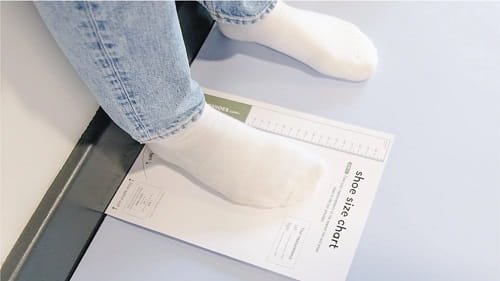
Measuring your foot directly is the most reliable way to find your true shoe size — especially before an online purchase or when trying a new brand. All you need is a sheet of paper, a pen, and a ruler or measuring tape.
Steps to Follow:
- Place a plain A4 sheet of paper on a hard, flat floor — do not measure on carpet as it compresses under your foot.
- Wear the type of socks you plan to wear with the shoes — or measure barefoot if buying sandals or open shoes.
- Stand upright on the paper with your full weight on the foot being measured — sitting down gives a smaller measurement because the foot expands under body weight.
- Using a pen or pencil held vertically (not at an angle), trace the outline of your entire foot — from the heel to the tip of the longest toe.
- Remove your foot and use a ruler to measure two dimensions: the length from the bottom of the heel mark to the tip of the longest toe mark, and the width at the widest point of the foot (usually across the ball of the foot).
- Record the length in centimetres — this is your foot length, the primary measurement for shoe sizing.
- Repeat the process for the other foot — most people have one foot slightly larger than the other. Always size for the larger foot.
- Use the size conversion table later in this guide to convert your foot length in centimetres to your shoe size in any sizing system.
Pro Tip: Measure your feet in the afternoon or evening — feet naturally swell slightly throughout the day due to activity and gravity. Shoes bought based on a morning measurement may feel tight by evening.
Method 2: Check the Size of a Shoe You Already Own and Fits Well
If you own a pair of shoes that fits perfectly, you can use that pair to determine your size in a different brand or sizing system without measuring your foot again. This is the quickest method for online shopping.
Steps to Follow:
- Pick a pair of shoes that you know fits you well and comfortably — one that you wear regularly without any discomfort.
- Look inside the shoe for the size label — it is usually printed on the insole (the inner sole), the tongue of the shoe, or stamped on the side of the outsole.
- Note the size number and the sizing system it belongs to — for example, “UK 8,” “US 9,” “EU 42,” or simply a number without a label (which is usually the local sizing system of the country where the shoe was manufactured).
- For a more precise reference, remove the insole from the shoe and measure its length from heel to toe in centimetres using a ruler. The insole is typically 1 to 1.5 cm longer than your actual foot length.
- Use this measurement or size number with the conversion chart in this guide to find the equivalent size in any other system.
- When buying a new pair from a different brand, keep in mind that fit can vary — always check that brand’s specific size guide if available, as some brands run large or small.
Note: The size printed inside a shoe is the size the manufacturer assigned — it may not perfectly match another brand’s equivalent number. Always cross-reference with foot length in centimetres for the most accurate comparison across brands.
Method 3: Get Measured at a Shoe Store with a Brannock Device
Most reputable shoe stores — including sports retailers, formal shoe shops, and children’s shoe stores — have a Brannock device: the metal or plastic measuring tool that has been the industry standard for professional shoe sizing for decades. Getting measured on a Brannock device gives you the most complete sizing information in one step.
Steps to Follow:
- Visit a shoe store that has a Brannock device — ask the store assistant to measure your feet if you do not see the device on display.
- Remove your shoes and stand on the device with your heel pressed firmly into the heel cup at the back.
- The store assistant will read three measurements: overall foot length (from heel to longest toe), arch length (from heel to the ball of the foot), and foot width.
- The arch length is particularly important — if your arch length is longer than your foot length measurement, size up to accommodate the arch correctly.
- Have both feet measured — as noted earlier, one foot is often larger. The assistant will recommend the size that fits the larger foot.
- Use the size recommended by the Brannock measurement as your baseline when trying on shoes — then fine-tune based on how the actual shoe feels when worn.
Pro Tip: Even if you know your size well, getting a professional Brannock measurement once a year is worthwhile — feet can change in size and shape with age, weight changes, and pregnancy. Many adults are unknowingly wearing the wrong size.
Method 4: Use a Shoe Size App or Online Foot Measurement Tool
Several brands and apps now offer smartphone-based foot measurement tools that use your phone’s camera and augmented reality or photogrammetry to measure your foot dimensions digitally and recommend a size — useful for online shopping without any physical measuring tools.
Steps to Follow:
- Search the Google Play Store or Apple App Store for “shoe size finder” or “foot measurement app” — popular options include Nike Fit (available on the Nike app), Reebok Size Finder, and Bata’s size guide tool.
- Open the app and follow the on-screen instructions — most apps ask you to place your foot on a flat surface, place a standard A4 sheet of paper next to your foot for scale, and take a photo from directly above.
- The app uses the paper as a size reference to calculate your foot length and width in centimetres.
- The result is displayed as a recommended shoe size in your chosen sizing system — usually alongside alternative sizes for width fitting.
- For online shopping on platforms like Amazon, Flipkart, or Myntra, check if the specific brand has a size guide chart on their product page — enter your measured foot length to find the recommended size.
- Always read customer reviews mentioning fit — comments like “runs small,” “runs large,” or “true to size” from verified buyers are extremely valuable for calibrating your size choice.
Pro Tip: Nike Fit, available in the Nike app, uses augmented reality to scan your foot with the phone camera and recommends the correct Nike size — it is one of the most accurate brand-specific sizing tools currently available.
Method 5: Check Children’s Shoe Size
Children’s feet grow quickly — often half a size or more every two to three months for toddlers, and roughly one full size every three to four months for older children. Checking a child’s shoe size regularly is essential for foot health and comfort.
Steps to Follow:
- Measure the child’s foot using the paper-and-ruler method described in Method 1 — have the child stand with full weight on their foot for an accurate measurement.
- Measure both feet and use the larger measurement.
- Add 1 to 1.5 cm to the measured foot length to allow growing room — children’s shoes should have a thumb’s width of space (approximately 1 cm) between the longest toe and the end of the shoe.
- Use the children’s size conversion table to find the correct size — children’s sizing systems are different from adult systems in India, the UK, US, and Europe.
- When buying in person, have the child try the shoe on and perform the thumb-press test: press your thumb down just above the longest toe with the child standing — there should be a small gap but no more than a thumb’s width.
- Re-check the child’s shoe size every 2 to 3 months for children under five, and every 3 to 4 months for older children — do not assume last month’s size is still correct.
Note: Never buy children’s shoes that are more than 1.5 cm too large — oversized shoes cause tripping, reduce stability, and can create toe deformities as the child’s foot compensates for the excess space.
Method 6: Try the Shoe On and Test for Fit
When buying in a physical store, the most reliable final check is always trying the shoe on — measurements and size charts are guides, but the actual feel of the shoe on your foot is the ultimate test of correct fit.
Steps to Follow:
- Always try on both shoes of the pair — the left and right shoes of the same pair can occasionally differ slightly.
- Wear the socks you intend to wear with the shoes — thin socks give more space than thick sports socks, and this difference matters.
- Stand up fully and walk a few steps — fit changes between sitting and standing. Never judge a shoe’s fit while sitting down.
- Check toe room: there should be approximately 1 to 1.5 cm of space (roughly a thumb’s width) between your longest toe and the front of the shoe when standing.
- Check the heel: the heel should feel snug but not tight — it should not slip when you walk. Heel slippage causes blisters and inefficient movement.
- Check the width: the widest part of your foot (the ball) should align with the widest part of the shoe. If the sides of your foot bulge over the sole, the shoe is too narrow.
- Walk on different surfaces if possible — many stores have a small hard floor area alongside carpet. Notice if there are any pressure points or pinching sensations.
- If any part of the shoe causes immediate discomfort, it will only get worse with wear — do not buy expecting the shoe to “break in” if the fit is fundamentally wrong.
Pro Tip: If you are between two sizes, always go for the larger one. A slightly larger shoe can be managed with thicker socks or an insole — a slightly smaller shoe cannot be made larger and will cause pain.
Quick Reference: Shoe Size Check Methods
Use this table to choose the best method for your situation:
| Method | Accuracy | Best Use Case |
| Paper + Ruler Measurement | Highest | Online shopping, international brands, first-time sizing |
| Existing Well-Fitting Shoe | High | Quick reference for online orders in same or new brand |
| Brannock Device at Store | Highest | Professional sizing, sports shoes, children’s shoes |
| Shoe Size App | Good | Online shopping with brand-specific fit recommendation |
| Children’s Size Check | Essential (every 2–3 months) | Growing children’s regular foot health check |
| Try On + Fit Test | Definitive | In-store purchase — final confirmation before buying |
International Shoe Size Conversion Chart (Adults)
Use this table to convert your foot length in centimetres to the equivalent shoe size across the most commonly used sizing systems:
| Foot Length (cm) | India / UK | US (Men) | US (Women) | EU |
| 22.5 cm | 4 | 5 | 6 | 36 |
| 23.5 cm | 5 | 6 | 7 | 37 |
| 24.0 cm | 6 | 7 | 8 | 38 |
| 24.5 cm | 6.5 | 7.5 | 8.5 | 39 |
| 25.0 cm | 7 | 8 | 9 | 40 |
| 25.5 cm | 7.5 | 8.5 | 9.5 | 41 |
| 26.0 cm | 8 | 9 | 10 | 42 |
| 26.5 cm | 8.5 | 9.5 | 10.5 | 42.5 |
| 27.0 cm | 9 | 10 | 11 | 43 |
| 27.5 cm | 9.5 | 10.5 | — | 44 |
| 28.0 cm | 10 | 11 | — | 45 |
| 28.5 cm | 10.5 | 11.5 | — | 45.5 |
| 29.0 cm | 11 | 12 | — | 46 |
Note: Size conversions are approximate averages and may vary slightly between brands. Always use your actual foot length in centimetres as the primary reference, and check the specific brand’s size guide when available.
Common Shoe Sizing Problems and How to Solve Them
Here are solutions to the most common shoe sizing challenges:
- One foot is larger than the other: This is completely normal — studies show the majority of people have feet of slightly different sizes. Always buy for the larger foot and use an insole or thicker sock on the smaller foot to compensate.
- Between two sizes: Always go half a size or one size up rather than down. You can manage a slightly larger shoe with insoles, heel grips, or thicker socks — you cannot make a smaller shoe work without damaging your feet.
- Wide feet that do not fit standard shoes: Look for shoes labelled “Wide” (W) or “Extra Wide” (XW/EE/EEE) — many brands now offer wide-fit versions of popular models. Indian brands like Bata and Liberty generally run wider than international brands.
- Shoes feel fine in the store but hurt after an hour: This often means the shoe is slightly too small or too narrow — feet swell with activity. If the shoe felt borderline in the store, size up. Never rely solely on the initial feel in a stationary try-on.
- Online shoe purchase does not fit as expected: Check whether the brand runs true to size, small, or large — use the brand’s own size guide chart first, then check customer reviews. If the size is wrong, most major online retailers in India offer free returns and exchanges.
- Shoe size seems to have changed as an adult: This happens — feet can grow or widen with age, weight gain, pregnancy, or the natural flattening of the foot arch. Re-measure your feet if you have not done so in over a year.
Conclusion
Finding the right shoe size is a combination of accurate measurement, smart size conversion, and listening to how the shoe actually feels on your foot. Measuring your foot at home with a sheet of paper and ruler takes five minutes and gives you a reliable foundation for any shoe purchase — in-store or online, domestic or international.
Always measure both feet, size for the larger one, shop in the afternoon when feet are at their natural largest, and when in doubt — size up. Your feet carry you through every day of your life — giving them the correct fit is one of the simplest and most impactful things you can do for your long-term comfort and health.

Santosh Kumar, the author behind IndiasStuffs.com, is passionate about sharing valuable insights on a variety of topics, including lifestyle, technology, and Indian culture.
Page Contents