India’s bridge-building story stretches from colonial-era steelwork over the Hooghly to record-setting sea links and Himalayan railway arches. Early structures relied on riveted trusses and cantilevers; today, engineers use orthotropic steel decks, cable-stayed systems, seismic bearings, corrosion-resistant marine detailing and automated vertical-lift spans.
These bridges do far more than cross water. They shorten journeys, open industrial corridors, connect islands and frontier regions, carry strategic traffic and become landmarks in their own right. This 2026 list considers engineering distinction, historic importance, scale, connectivity impact and architectural identity.
1. Atal Setu / Mumbai Trans Harbour Link, Maharashtra
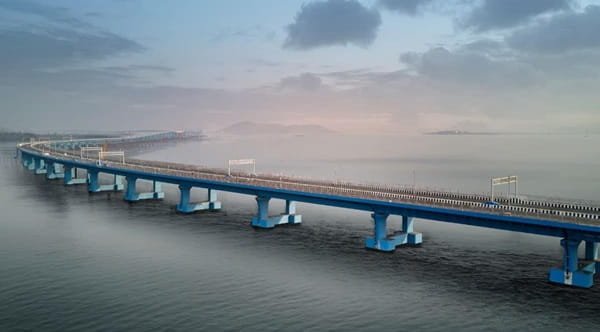
Atal Bihari Vajpayee Sewri-Nhava Sheva Atal Setu is India’s longest bridge and longest sea bridge. The six-lane Mumbai Trans Harbour Link runs 21.8 km, including about 16.5 km over the sea, linking Sewri with Nhava Sheva. Opened in January 2024, it creates a high-capacity route toward Navi Mumbai and the airport corridor.
The project combines long marine viaducts with orthotropic steel deck sections at major navigation spans. Seismic protection, noise barriers and marine-durability measures are built into the design. Its real importance lies in reshaping travel across Mumbai Harbour and strengthening links between Mumbai, Navi Mumbai and major port zones.
2. Chenab Rail Bridge, Jammu & Kashmir
The Chenab Rail Bridge is the defining structure of the Udhampur-Srinagar-Baramulla Rail Link. Located between Bakkal and Kauri in Reasi district, the 1,315-metre steel arch bridge rises 359 metres above the riverbed, making it the world’s highest railway arch bridge and about 35 metres taller than the Eiffel Tower.
Its main arch spans 467 metres across a steep Himalayan gorge. Designed for extreme wind, seismic and temperature conditions, the bridge has a stated design life of 120 years. Inaugurated in June 2025, it is now an operational part of all-weather railway connectivity to the Kashmir Valley.
3. Howrah Bridge / Rabindra Setu, Kolkata, West Bengal
Commissioned in 1943, Howrah Bridge is a balanced cantilever steel bridge across the Hooghly and one of Kolkata’s defining landmarks. The structure is about 705 metres long, with a central span of roughly 457 metres, linking Kolkata with Howrah.
It used around 26,500 tonnes of steel and is famous for having no conventional nuts and bolts in its main steelwork; the structure was assembled by riveting. Renamed Rabindra Setu in 1965, its dense steel lattice remains both a transport workhorse and a remarkable example of large-scale pre-welded bridge construction.
4. Dr. Bhupen Hazarika Setu / Dhola-Sadiya Bridge, Assam
The Dr. Bhupen Hazarika Setu stretches 9.15 km across the Lohit River, a major Brahmaputra tributary. Opened in 2017, the beam bridge links Dhola and Sadiya in Assam and provides far better road access toward eastern Arunachal Pradesh.
Its importance is economic and strategic. The bridge replaced slow ferry-dependent travel, reduced journey times and created a permanent road connection in a river-dominated region. It was designed to carry 60-tonne military tanks, adding defence value near India’s northeastern frontier. Its engineering strength lies less in dramatic form than in scale, repetition and resilience across a broad alluvial river system.
5. New Pamban Bridge, Rameswaram, Tamil Nadu
The New Pamban Bridge is India’s first vertical-lift railway sea bridge, replacing the century-old rail connection to Rameswaram Island. Inaugurated in April 2025, it extends about 2.08 km across the Palk Strait and includes 99 approach spans plus a 72.5-metre navigational lift span.
That central span can rise 17 metres to allow ships through. Stainless reinforcement, fully welded joints and specialised anti-corrosion coatings improve durability in the marine environment. The substructure is prepared for two tracks, although the initial superstructure carries a single line, making the bridge a future-ready movable railway crossing.
6. Bandra-Worli Sea Link / Rajiv Gandhi Sea Link, Mumbai
Before Atal Setu, the Bandra-Worli Sea Link defined modern bridge engineering in Mumbai. The approximately 5.6-km, eight-lane crossing links Bandra and Worli across Mahim Bay, combining prestressed concrete-steel viaducts with signature cable-stayed spans.
The first four lanes opened in June 2009, and all eight were operational by March 2010. Its tall pylons and stay cables turned transport infrastructure into a city landmark, while the link sharply reduced peak travel time between Bandra and Worli. Offshore foundations, precast segmental construction and cable-stayed navigation sections made it a major milestone in Indian marine bridge engineering.
7. Bogibeel Bridge, Assam
Bogibeel Bridge carries road and rail traffic across the Brahmaputra between Dibrugarh and Dhemaji districts. At 4.94 km, it is India’s longest combined rail-cum-road bridge, with a road deck above and railway lines below. It opened in December 2018.
The bridge uses large steel truss girders suited to the demanding Brahmaputra environment. Its impact has been substantial: journeys that once depended on ferries or long detours became direct, improving access to markets, healthcare and Arunachal Pradesh. Bogibeel is also strategically important because the double-deck corridor supports rapid movement of passengers, freight and defence logistics.
8. Sudarshan Setu, Okha-Bet Dwarka, Gujarat
Sudarshan Setu connects Okha on the Gujarat mainland with Bet Dwarka island, ending dependence on boats for routine road access. Inaugurated in February 2024, the 2.32-km bridge is officially described by the Government of India as the country’s longest cable-stayed bridge by overall bridge length.
Its pedestrian walkways carry Bhagavad Gita verses and images of Krishna, while solar panels over sections of the footpath can generate about 1 MW of electricity. The bridge gives pilgrims and residents an all-weather road connection and has quickly become a major architectural landmark on the Saurashtra coast.
9. Mahatma Gandhi Setu, Patna-Hajipur, Bihar
Mahatma Gandhi Setu is a crucial crossing of the Ganga between Patna and Hajipur. The approximately 5.575-km, four-lane bridge has linked north and south Bihar since the 1980s and remains vital to regional trade and long-distance traffic.
Decades of heavy use damaged the original prestressed concrete cantilever superstructure. A major rehabilitation dismantled those distressed cantilever arms and replaced them with a steel truss superstructure, while much of the substructure was retained. Completed in 2022, the project made Gandhi Setu a notable case study in extending the life of a major bridge through large-scale structural replacement.
10. Vidyasagar Setu / Second Hooghly Bridge, Kolkata, West Bengal
Opened in 1992, Vidyasagar Setu introduced cable-stayed engineering to Kolkata’s skyline. The main bridge is 823 metres long, with a 457-metre central span, 35-metre-wide composite deck and steel pylons approximately 128 metres high.
Its stays form a distinctive fan arrangement. Popular references often cite 121 cables, while HRBC’s current salient-feature sheet specifies four groups of 38 stays; the difference reflects varying counting descriptions. What is undisputed is the bridge’s importance as an early Indian cable-stayed landmark. Elegant, wide and structurally expressive, it remains a major Hooghly crossing between Kolkata and Howrah.
Conclusion
India’s most famous bridges trace a remarkable engineering journey. Howrah Bridge represents riveted steel craftsmanship; Vidyasagar Setu and Bandra-Worli brought cable-supported urban landmarks; Atal Setu and New Pamban demonstrate modern marine construction; and Chenab shows what is possible in extreme mountain terrain.
Beyond 2026, the challenge is not merely to build longer or higher. India’s next generation of bridges must combine structural ambition with durability, smart monitoring, corrosion protection, seismic resilience and efficient maintenance. The strongest legacy will be infrastructure that performs safely for decades while transforming the regions it connects.