The tabla is one of the defining voices of Hindustani classical music. Its two drums – the higher-pitched wooden dayan and deeper bayan – can whisper, thunder and bend pitch with remarkable precision. The black syahi at each drumhead’s centre helps create the clear, ringing tone. Delhi, Ajrara, Lucknow, Farrukhabad, Benares and Punjab traditions developed distinct vocabularies of bol, kayda, peshkar, rela, tukra and tihai.
Once heard mainly as accompaniment, tabla became a major solo concert art. Its finest exponents turned layakari into musical architecture, making complex calculation sound spontaneous. This 2026 edition profiles ten masters whose technique, teaching and international work continue to shape how India and the world hear tabla.
1. Ustad Zakir Hussain
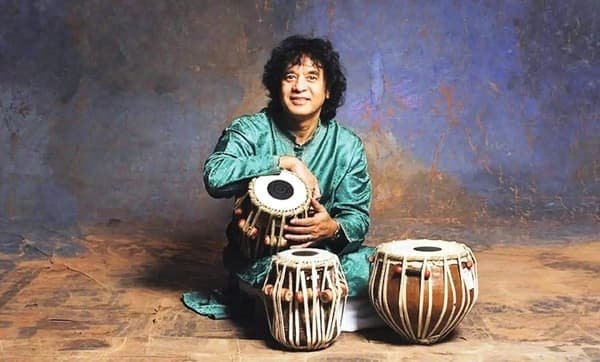
Ustad Zakir Hussain remains the most globally recognised tabla virtuoso of the modern era. A son and disciple of Ustad Alla Rakha, he inherited the Punjab gharana’s robust vocabulary but developed an intensely personal language marked by crystalline bols, extraordinary finger speed, dynamic control and highly musical bayan modulation.
Collaborations with Shakti, Mickey Hart, John McLaughlin and classical masters expanded tabla’s reach without weakening its grammar. Hussain received the Padma Shri in 1988, Padma Bhushan in 2002 and Padma Vibhushan in 2023. The Recording Academy lists four Grammy wins and nine nominations through 2026. He died in December 2024, but his influence remains central to percussion.
2. Ustad Alla Rakha
Ustad Alla Rakha was the Punjab gharana giant who helped move tabla from the accompanist’s corner to the centre of the international concert stage. Trained by Mian Qadir Baksh, he combined weighty open strokes, supple rhythmic response and effortless dialogue with a soloist.
His long partnership with Pandit Ravi Shankar introduced international audiences to the conversational power of Hindustani tala and showed that tabla could command attention as an equal voice. Alla Rakha received the Padma Shri in 1977 and the Sangeet Natak Akademi Award in 1982. As guru to Zakir Hussain, Fazal Qureshi, Taufiq Qureshi and Yogesh Samsi, his legacy also survives through pedagogy.
3. Pandit Anindo Chatterjee
Pandit Anindo Chatterjee is one of the great modern exponents of the Farrukhabad gharana. A disciple of Pandit Jnan Prakash Ghosh, he is admired for tonal sweetness, carefully rounded bols, elegant peshkar development and an enormous command of traditional compositions.
His playing can be mathematically exact without sounding mechanical; dense kaydas and relas retain shape and breath. Chatterjee has accompanied major Hindustani artists while remaining an important soloist. He received the Sangeet Natak Akademi Award in 2002. In 2022, he declined an offered Padma Shri, saying it had come too late in his career. His influence on younger tabla players remains immense.
4. Pandit Swapan Chaudhuri
Pandit Swapan Chaudhuri is a leading Lucknow gharana representative, trained under Pandit Santosh Krishna Biswas and Pandit P. L. Rana. His tabla is celebrated for clarity, balance and grace. In solo playing, he develops compositions patiently, allowing the architecture of a kayda or bandish to emerge with unusual transparency.
Chaudhuri became a trusted accompanist to artists including Ustad Ali Akbar Khan, Pandit Ravi Shankar and Pandit Nikhil Banerjee. His long teaching career, particularly through the Ali Akbar College of Music in the United States, helped establish serious tabla pedagogy outside India. He received the Sangeet Natak Akademi Award for 1997.
5. Pandit Kishan Maharaj
Pandit Kishan Maharaj was one of the titans of the Benares gharana. Trained by Pandit Kanthe Maharaj, he brought a commanding open-handed sound to tabla, with powerful na, dha and dhin strokes, explosive tukras, chakradars and tihais, and an instinctive sense of stage drama.
He excelled in solo tabla, Hindustani accompaniment and Kathak, answering complex footwork with electrifying precision. Kishan Maharaj received the Padma Shri in 1973, Sangeet Natak Akademi Award in 1984 and Padma Vibhushan in 2002; he was later elected an Akademi Fellow. His playing remains a reference point for the muscular yet sophisticated Benares baaj.
6. Pandit Kumar Bose
Pandit Kumar Bose is a major contemporary torchbearer of the Benares gharana. Son of tabla player Acharya Biswanath Bose and later a disciple of Pandit Kishan Maharaj, he absorbed the gharana’s bold resonance, dramatic layakari and love of intricate tihai construction.
Bose is known for explosive power, quick transitions and accompaniment that responds closely to the melodic artist. His long association with Pandit Ravi Shankar took him worldwide. He received the Sangeet Natak Akademi Award in 2006, and in 2026 the Government of India honoured him with the Padma Shri.
7. Pandit Suresh Talwalkar
Pandit Suresh Talwalkar is one of India’s most adventurous tabla gurus and performers. Rooted principally in a Farrukhabad lineage, he also absorbed ideas from Delhi, Ajrara, Lucknow and Benares, while studying Carnatic laya under Ramnad Ishwaran.
That training shaped a style where composition, vocal recitation and rhythmic design interact closely. Talwalkar is known for Taal Mala and Jod Taal concepts and for mentoring performers including Satyajit Talwalkar, Ramdas Palsule and Vijay Ghate. He received the Sangeet Natak Akademi Award in 2004 and the Padma Shri in 2013.
8. Pandit Yogesh Samsi
Pandit Yogesh Samsi is one of the strongest living exponents of the Punjab gharana. After early training with Pandit Taranath Rao, he began a long discipleship under Ustad Alla Rakha at the age of ten and studied with him for more than two decades.
Samsi is admired for disciplined bol articulation, controlled bayan work and classical structure even at high speed. As an accompanist, he adjusts density, volume and rhythmic pressure to the artist in front of him. He is also an influential teacher. The Sangeet Natak Akademi selected him for its 2017 award in Hindustani instrumental music – tabla.
9. Satyajit Talwalkar
Satyajit Talwalkar represents a generation for whom deep classical training and cross-cultural collaboration are not opposites. The son and disciple of Pandit Suresh Talwalkar and vocalist Padma Talwalkar, he grew up in a rigorous musical environment and performed on stage as a child.
His tabla combines speed, clean articulation and dynamic control with his father’s multi-gharana rhythmic outlook. He has accompanied Hariprasad Chaurasia, Shivkumar Sharma, Amjad Ali Khan and Jasraj, while also joining modern collaborations. His honours include the Sangeet Natak Akademi’s Ustad Bismillah Khan Yuva Puraskar and the Aditya Birla Kala Kiran Puraskar.
10. Anuradha Pal
Anuradha Pal is one of the most important women to have built a sustained professional identity around tabla performance. Trained within the Ustad Alla Rakha-Zakir Hussain lineage and exposed to repertoire from several gharanas, she developed a concert style based on bright tonal projection, rapid tayyari and theatrical rhythmic storytelling.
Her significance goes beyond virtuosity. Pal challenged a field long dominated by men and founded Stree Shakti, an all-women classical and fusion ensemble. She has been recognised as a pioneering professional female tabla artist, received the Government of India’s First Ladies honour in 2018 and the Maharashtra Sanskrutik Puraskar, and continues to teach and create rhythm-led projects.
Conclusion
These ten artists show why tabla is far more than a timekeeping instrument. Alla Rakha and Zakir Hussain made its language global; Kishan Maharaj and Kumar Bose carried Benares power; Anindo Chatterjee and Swapan Chaudhuri represented refinement; Suresh Talwalkar, Yogesh Samsi and Satyajit Talwalkar expanded rhythmic thought; Anuradha Pal opened doors for women in professional percussion.
Beyond 2026, tabla’s future will depend on rigorous riyaaz, respect for gharana vocabulary and fearless improvisation. As long as a single bol can carry both mathematics and emotion, Indian percussion will continue to speak to audiences everywhere.