Few Indian crops can enter a vegetable mandi, a nutrition store, a herbal-powder unit and an export catalogue from the same plant. Moringa does exactly that. Better known as drumstick or sahjan, Moringa oleifera supplies tender pods for curries, protein- and micronutrient-rich leaves for fresh use and powder, and seeds with value for oil and other industrial applications. What was once mainly a backyard or boundary tree has therefore become a serious commercial crop in several parts of India.
The biggest change in 2026 is the quality of planting material available to farmers. Annual seed-propagated cultivars such as PKM 1 and PKM 2 transformed commercial drumstick farming in South India, while newer releases are widening the choice. TNAU released the perennial PKM 3 in 2024, and ICAR’s Thar Harsha and Thar Tejas are designed for rain-fed semi-arid conditions. Karnataka, Kerala and farmer-innovation systems also contribute compact, early and region-specific moringa types.
For growers, the “best” moringa is not simply the one with the longest pod. Annual versus perennial habit, first bearing, pod tenderness, yield, drought performance, plant height and market purpose all matter. A variety ideal for fresh drumsticks may not be the best for leaf harvest or a low-maintenance perennial orchard. Now, let’s check out the top 10 moringa varieties in India!
1. PKM 1
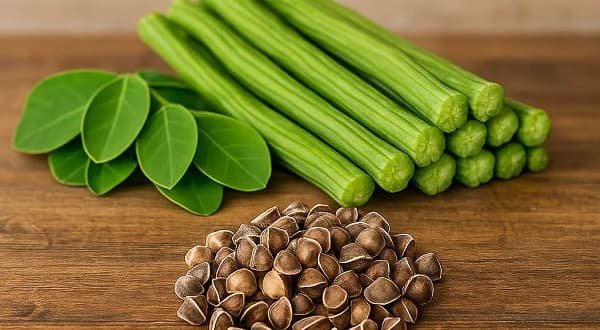
PKM 1 is the variety that changed commercial moringa cultivation in India. Developed by Tamil Nadu Agricultural University at Periyakulam, this seed-propagated annual type replaced many variable perennial trees because it bears early, stays bushier and produces uniform marketable pods.
- Origin: Horticultural College and Research Institute, TNAU, Periyakulam; released in 1989.
- Plant type: Annual, seed-propagated and bushy.
- Bearing: Precocious and capable of commercial harvest within the first year.
- Pod profile: Green, fleshy, non-bitter pods commonly around 1 metre long in TNAU descriptions.
- Pod load: About 250–350 fruits per tree per year.
- Yield potential: Roughly 50–54 tonnes/ha under recommended production.
- Commercial strength: Low-fibre pods, soft seeds, good transport tolerance and strong consumer acceptance.
2. PKM 2
PKM 2 was developed as a higher-performing annual successor to PKM 1. Its biggest visual advantage is the exceptionally long, fleshy pod, which is attractive in fresh markets where uniform length and edible flesh are rewarded.
- Origin: TNAU, Periyakulam; released in 2000.
- Breeding: Hybrid derivative from the cross MP 31 × MP 28.
- Plant type: Medium-tall annual type propagated by seed.
- Pod profile: Approximately 125 cm long, about 8.3 cm in girth and around 280 g per pod.
- Eating quality: Fleshier pods with fewer seeds.
- Yield: TNAU technical literature places varietal potential around 98 tonnes/ha; intensive high-density trials have reported still higher yield.
- Best use: Commercial pod farming where long, fleshy drumsticks have a strong market.
3. PKM 3
PKM 3 is the most important recent TNAU moringa release for a 2026 list. Released in 2024 as a perennial type, it offers farmers who do not want to re-establish an annual crop every season a high-yielding, long-lived alternative.
- Origin: Tamil Nadu Agricultural University; released in 2024.
- Plant type: Perennial, with an expected productive life of roughly 10–15 years under good management.
- Pod profile: Medium-long pods around 47–55 cm.
- Pod load: About 250 pods per plant in TNAU/KVK technology descriptions.
- Yield: Around 68.7 tonnes/ha/year.
- Crop strength: Lower incidence of pod fly, leaf-eating caterpillar and root rot has been reported.
- Best use: Perennial commercial orchards and farmers seeking repeated annual pod harvest without replanting every year.
4. Thar Harsha
Thar Harsha is a climate-resilient moringa developed by ICAR for rain-fed semi-arid India. It is particularly important outside traditional irrigated South Indian production because it was selected under the dry conditions of Godhra, Gujarat.
- Origin: ICAR-Central Horticultural Experiment Station, Godhra.
- Plant type: Annual with dense foliage and dark-green leaves.
- Bearing season: Later fruiting than PKM 1, generally extending through March–May in ICAR evaluation.
- Pod load: About 314 pods per plant per year.
- Yield potential: Approximately 53–54.7 tonnes/ha.
- Nutritional strength: ICAR recorded high dry matter, protein and mineral levels in its leaves and pods.
- Best use: Rain-fed and semi-arid commercial cultivation, nutrition gardens and diversified pod-plus-leaf farming.
5. Thar Tejas
Thar Tejas is the companion ICAR variety to Thar Harsha but is distinguished by earlier flowering and harvest. It combines a manageable plant size with heavy individual pods under semi-arid rain-fed conditions.
- Origin: ICAR-Central Horticultural Experiment Station, Godhra.
- Plant size: Around 2.7 m tall in ICAR evaluation.
- Pod load: Approximately 245 pods per plant.
- Pod profile: Around 45–48 cm long, about 218 g each and carrying roughly 9–10 seeds.
- Harvest season: January–March under the Godhra production environment.
- Leaf quality: High antioxidant activity and useful vitamin/phenolic traits have been reported.
- Best use: Semi-arid farms looking for earlier harvest and substantial pod weight.
6. Bhagya (KDM 1)
Bhagya, also known as KDM 1, is a well-known Karnataka moringa developed through the University of Horticultural Sciences system. It is valued for compact management, early bearing and suitability for high-density planting in hot, relatively dry regions.
- Origin: University of Horticultural Sciences, Bagalkot, Karnataka.
- Plant habit: Perennial dwarf to semi-dwarf type that can be kept around 2–4 m through pruning.
- Bearing: Early flowering and suitable for intensive orchard management.
- Pod production: Technical descriptions commonly report several hundred pods per plant under good management.
- Climate fit: Adapted to hot and dry conditions.
- Longevity: Can remain productive for many years when regularly pruned and protected from borers.
- Best use: High-density perennial planting and farms targeting both pods and repeated leaf harvest.
7. Dhanaraj
Dhanaraj is a compact Karnataka drumstick developed for growers who want a smaller canopy without sacrificing pod number. Its dwarf stature makes harvesting and pruning easier than in tall traditional trees.
- Origin: Karnataka agricultural university breeding programme; also referred to as S 6/4.
- Plant habit: Dwarf, with a canopy around 2–2.5 m.
- Bearing: Flowers in roughly 7–8 months.
- Pod load: Around 250–300 pods per plant per year in technical descriptions.
- Eating quality: Pods are considered suitable for cooking and fresh vegetable use.
- Management advantage: Smaller trees reduce harvesting difficulty and suit closer orchard management.
- Best use: Commercial farms seeking an early, manageable seed-propagated drumstick type.
8. Anupama
Anupama is Kerala Agricultural University’s recognised high-yielding drumstick variety. It is particularly valuable because it gives Kerala farmers a locally developed option rather than relying only on Tamil Nadu annual types.
- Origin: Kerala Agricultural University; released in 2010.
- Plant type: High-yielding moringa with early flowering habit.
- Regional fit: Recommended particularly for Kerala’s Central Zone.
- Propagation: KAU recommendations use vegetative planting material for maintaining desirable type.
- Yield: Traditional KAU package recommendations report around 10–15 kg pods per tree per year under the specified system.
- Current research value: KAU continued research on propagation and grafting of Anupama in 2025.
- Best use: Kerala homesteads and regional farms wanting a locally tested moringa cultivar.
9. GKVK 1
GKVK 1 is a compact drumstick developed by the University of Agricultural Sciences, Bengaluru. Its dwarf habit is its main attraction because it is easier to accommodate in high-density systems than very tall perennial landraces.
- Origin: University of Agricultural Sciences, GKVK, Bengaluru.
- Plant habit: Dwarf; technical literature places plant height around 1.5 m.
- Pod load: Commonly reported around 250–300 pods per plant per year.
- Pod profile: Medium-sized pods, roughly 35 cm in older technical descriptions.
- Orchard advantage: Compact canopy simplifies harvesting, pruning and high-density layout.
- Best use: Karnataka conditions and farms where restricted plant height is an important management advantage.
10. Rohit 1
Rohit 1 is an improved farmer-innovation moringa recognised through India’s National Innovation Foundation ecosystem. It stands out for early fruiting and medium-length dark-green pods with strong fresh-market appeal.
- Background: Improved selection developed from Shabnam and documented by the Principal Scientific Adviser’s innovation platform.
- Bearing: Begins fruiting in about six months.
- Pod profile: Dark-green, export-quality pods around 50 cm long.
- Pod load: Up to about 150 pods per plant annually in innovation documentation.
- Yield: Older established plants have produced up to about 61 kg of pods per plant.
- Adoption: Reported in Maharashtra, Gujarat, Madhya Pradesh, Karnataka and Chhattisgarh.
- Best use: Fresh-market farmers who value earlier bearing and medium-length uniform pods.
Practical Farmer’s & Buyer’s Guide
- Choose annual or perennial first: PKM 1 and PKM 2 suit annual seed-based commercial systems, while PKM 3, Bhagya and other perennial types reduce the need for yearly re-establishment.
- Match climate: Thar Harsha and Thar Tejas are particularly interesting for semi-arid rain-fed areas, while Anupama is a Kerala-specific option.
- Do not judge by pod length alone: Very long pods may look impressive, but tenderness, fibre, seed hardness, shelf life and local buyer preference determine market value.
- Use authentic planting material: Buy seed or vegetative plants from agricultural universities, ICAR/KVK systems or traceable suppliers. Seed from unselected perennial trees can produce highly variable offspring.
- Pruning is essential: Moringa responds strongly to pinching, heading back and ratooning. A manageable branched canopy usually produces more accessible flowering shoots than an unpruned tall tree.
Conclusion
India’s moringa sector now offers much more than the familiar PKM 1. PKM 2 serves intensive long-pod farming, PKM 3 brings a modern perennial option, Thar Harsha and Thar Tejas extend commercial cultivation into semi-arid regions, while Bhagya, Dhanaraj, Anupama, GKVK 1 and Rohit 1 provide different advantages in plant size, region and market timing. In 2026, the best variety is the one that matches the farmer’s climate, irrigation, pruning system and target market.
Frequently Asked Questions
Q. Which moringa variety gives the highest yield in India?
PKM 2 has very high documented yield potential and is one of India’s strongest annual pod varieties. TNAU literature places its varietal yield around 98 tonnes/ha, while intensive high-density research has recorded even higher figures. Actual farm yield will depend on spacing, irrigation, pruning, nutrition and pest management.
Q. Which is the best moringa variety for dry areas?
Thar Harsha and Thar Tejas are among the strongest research-backed options for semi-arid rain-fed conditions because ICAR developed and evaluated them at Godhra, Gujarat. PKM 1 is also widely adaptable where irrigation is available.
Q. What is the difference between PKM 1 and PKM 2?
Both are annual TNAU moringa varieties. PKM 1 is the proven commercial benchmark with uniform, fleshy pods and broad adaptation. PKM 2 was bred later and produces much longer, heavier and fleshier pods with fewer seeds and higher potential yield.
Q. Which moringa variety is best for perennial cultivation?
PKM 3 is a particularly important 2026 choice because TNAU released it in 2024 as a high-yielding perennial moringa with around 68.7 tonnes/ha/year potential. Bhagya and Anupama are other perennial/regional options depending on location.