Carrot in India is no longer just the familiar winter red gajar sold in vegetable markets. Farmers can now choose deep-red carrots rich in lycopene, black carrots loaded with anthocyanins, orange European types rich in beta-carotene, and even heat-tolerant tropical cultivars that help extend production beyond the traditional winter window. This diversity has made carrot a much more flexible crop for fresh markets, juice, salad, halwa, pickles, processing and nutrition-focused retail.
The biggest change for 2026 is the range of public-sector varieties available for different seasons and regions. ICAR-IARI has developed tropical and temperate carrots that can collectively support near year-round production in North Indian conditions, while ICAR-IIVR and ICAR-IIHR have added newer coloured and tropical selections. TNAU’s Ooty 1 remains an important hill carrot where cool conditions favour deep colour and high root yield.
For farmers, the best carrot is not simply the reddest or longest root. Sowing season, soil texture, temperature, core colour, TSS, carotenoid content, bolting tendency and market purpose all matter. Deep, loose, stone-free soil is especially important because compact or cloddy soil causes forking and misshapen roots. Now, let’s check out the top 10 carrot varieties in India!
1. Pusa Rudhira
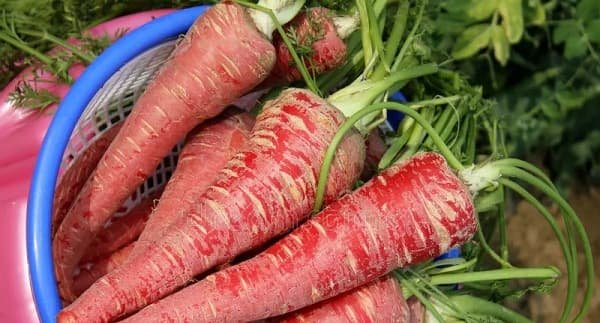
Pusa Rudhira is one of India’s strongest red carrots for commercial winter cultivation. Developed by ICAR-IARI, it combines attractive deep-red colour, self-coloured core, high marketable yield and strong nutritional value.
- Origin: ICAR-Indian Agricultural Research Institute, New Delhi.
- Type: Tropical/Asiatic red carrot.
- Root profile: Long, smooth, deep-red roots with a red self-coloured core.
- Maturity: About 75–90 days after sowing.
- Yield: Around 30–35 tonnes/ha in IARI recommendations; farmer demonstrations have recorded still higher yields.
- Quality: Rich in carotenoids, beta-carotene, lycopene, iron and zinc.
- Best use: Fresh market, salad, juice, halwa and premium red-carrot trade.
2. Kashi Arun
Kashi Arun is one of ICAR-IIVR’s most important newer red carrots and was nationally notified in 2022. Its attractive red roots, good TSS and strong lycopene content make it a modern alternative for growers in warmer tropical production zones.
- Origin: ICAR-Indian Institute of Vegetable Research, Varanasi.
- Notification: 2022 under AICRP-VC.
- Root profile: Attractive red, Danvers-shaped roots about 21–23 cm long and 110–125 g.
- Maturity: Around 90–100 days.
- Yield: About 300–350 q/ha.
- Quality: Around 8.5–9.0°Brix TSS, with roughly 7.25–7.50 mg/100 g lycopene and 3.5–3.7 mg/100 g beta-carotene.
- Recommended states: Madhya Pradesh, Maharashtra, Goa, Karnataka, Tamil Nadu, Kerala and Puducherry.
- Best use: Fresh market, salads, juice, halwa, pickles and lycopene-rich processing where deep-red root colour is preferred.
3. Pusa Vasuda
Pusa Vasuda is an important milestone because it was India’s first public-sector tropical carrot hybrid developed using a cytoplasmic male sterility system. It combines high yield with smooth, sweet red roots and strong pigment and mineral content.
- Origin: ICAR-IARI, New Delhi.
- Release: 2013 for Delhi and NCR.
- Type: Tropical F1 hybrid.
- Root profile: Smooth, vigorous, attractive red roots with a self-coloured core.
- Maturity: About 80–90 days.
- Yield: Around 40 tonnes/ha.
- Quality: Rich in total carotenoids, lycopene, TSS and minerals.
- Best use: Salad, juice extraction, cooking and carotenoid-processing industries.
4. Pusa Vrishti
Pusa Vrishti is one of the most useful carrots for extending production into hotter and more humid weather. ICAR-IARI developed it as a heat- and humidity-tolerant tropical carrot for very early sowing in North Indian plains.
- Origin: ICAR-IARI, New Delhi.
- Special trait: High heat and humidity tolerance.
- Sowing window: Suitable for sowing from July under North Indian plains.
- Root profile: Red roots with slight purple pigmentation on the shoulders and a self-coloured core.
- Maturity: About 85–95 days.
- Yield: Roughly 18–25 tonnes/ha depending on season and source.
- Best use: Early-season carrot production when conventional winter varieties struggle with temperature.
5. Pusa Asita
Pusa Asita is one of India’s standout black carrots and is especially valuable for nutraceutical and traditional food markets. Its intensely dark roots are rich in anthocyanins, giving the variety much stronger antioxidant value than ordinary red or orange carrots.
- Origin: ICAR-IARI, New Delhi.
- Type: Tropical black carrot.
- Root profile: Long black-purple roots with a self-coloured dark core.
- Maturity: Around 90–110 days.
- Yield: About 25–30 tonnes/ha.
- Nutrition: Anthocyanin content is about 520 mg/100 g in IARI descriptions, along with useful iron, calcium and zinc.
- Best use: Kanji, juice, salad, pickles, halwa, natural colour and nutraceutical products.
6. Arka Suraj
Arka Suraj is ICAR-IIHR’s important tropical orange carrot. Its major advantage is that it can flower and set seed under tropical conditions while producing smooth, deep-orange roots with high carotene content.
- Origin: ICAR-Indian Institute of Horticultural Research, Bengaluru.
- Root profile: Deep-orange, smooth, conical roots with a self-coloured core.
- Root size: Around 15–18 cm long and 3–4 cm in diameter.
- Quality: About 8–10°Brix TSS and approximately 11.27 mg% carotene.
- Crop strength: Tolerant to powdery mildew and nematodes.
- Breeding advantage: Sets seed under tropical conditions, unlike many temperate carrot types.
- Best use: Tropical and subtropical production where orange carotene-rich roots are preferred.
7. Pusa Nayanjyoti
Pusa Nayanjyoti is India’s first public-sector orange temperate carrot hybrid. It gives growers smooth, uniform roots and strong beta-carotene levels, particularly in cooler hill conditions and late-season plains production.
- Origin: ICAR-IARI.
- Release: 2009 for Himachal Pradesh.
- Type: Temperate orange F1 hybrid.
- Root profile: Smooth, uniform, cylindrical and stumpy orange roots with a small indistinct self-coloured core.
- Yield: Around 35–40 tonnes/ha.
- Quality: Beta-carotene about 7.55 mg/100 g fresh weight.
- Sowing: April–August in hills and November–December in North Indian plains.
- Best use: Premium orange-carrot fresh markets and temperate production zones.
8. Pusa Yamdagni
Pusa Yamdagni is a dependable temperate carrot that remains highly relevant in 2026; ICAR-IARI showcased it alongside Pusa Rudhira at its Winter Vegetable Field Day in February 2026. Its broad low-temperature adaptation makes it one of India’s most versatile orange carrots.
- Origin: ICAR-IARI Regional Station, Katrain.
- Release: 1988 through CVRC.
- Type: Temperate orange carrot.
- Root profile: Long, slightly tapering cylindrical roots with a self-coloured orange core.
- Maturity: Around 90–100 days.
- Yield: About 20–25 tonnes/ha in general IARI descriptions, with higher yields under some seasonal schedules.
- Adaptation: Low-temperature conditions throughout India; suitable for hills and cool-season plains.
- Best use: Fresh orange-carrot markets and multi-season production.
9. Pusa Meghali
Pusa Meghali is an important tropical orange carrot from ICAR-IARI and is useful because it can be sown both relatively early and later in the season. Its short tops and smooth roots make harvesting and market preparation easier.
- Origin: ICAR-IARI, New Delhi.
- Type: Tropical carrot developed using Pusa Kesar and Nantes material.
- Root profile: Smooth orange roots with a self-coloured core and short foliage.
- Sowing flexibility: Suitable for August–September sowing and also later October–November planting in some recommendations.
- Maturity: Around 110–120 days.
- Yield: About 25–30 tonnes/ha.
- Best use: Fresh orange-carrot markets where farmers want tropical adaptation with European-type colour.
10. Ooty 1
Ooty 1 is one of South India’s best-known hill carrots and remains a major TNAU recommendation for the Nilgiris and other suitable high-altitude regions. Its long, deep-orange roots and high yield make it particularly valuable under cool hill conditions.
- Origin: Horticultural Research Station, TNAU, Udhagamandalam.
- Regional fit: Hill areas, particularly elevations around or above 1,500–1,800 metres.
- Root profile: Long, deep-orange, slightly tapering roots with a thin self-coloured core.
- Maturity: Around 100–110 days.
- Yield potential: About 45–50 tonnes/ha in technical descriptions.
- Crop strength: Reported resistance to powdery mildew and leaf spot, with good hill adaptation.
- Best use: Nilgiris-type commercial carrot production and high-quality orange-root markets.
Practical Buyer’s & Farmer’s Guide
- Match variety to temperature: Tropical types such as Pusa Rudhira, Kashi Arun and Pusa Vrishti handle warmer conditions better, while Pusa Yamdagni, Pusa Nayanjyoti and Ooty 1 perform best under cooler environments.
- Choose colour by market: Red carrots are preferred for halwa and traditional North Indian winter markets; black carrots suit kanji and nutraceutical uses; orange carrots dominate salad and premium fresh retail.
- Prepare soil deeply: Carrot needs loose, stone-free, well-drained sandy loam. Stones, clods and compact soil cause forked, rough and misshapen roots.
- Harvest at the right stage: Over-mature carrots become coarse and fibrous. Market roots should be fully coloured, tender and uniform.
- Buy genuine seed: Use ICAR institutes, agricultural universities, KVK-linked outlets or authorised seed dealers, especially for hybrids such as Pusa Vasuda and Pusa Nayanjyoti.
Conclusion
India’s carrot varieties now offer far more than a choice between red and orange roots. Pusa Rudhira and Kashi Arun lead the red fresh-market segment, Pusa Asita serves black-carrot and nutraceutical demand, Pusa Vrishti extends production into warmer months, while Pusa Nayanjyoti, Pusa Yamdagni and Ooty 1 strengthen hill and cool-season cultivation. In 2026, the best variety is the one that matches temperature, root colour, market purpose and sowing window.
Frequently Asked Questions
Q. Which carrot variety gives the highest yield in this list?
Ooty 1 has a reported yield potential of around 45–50 tonnes/ha under suitable hill conditions. Pusa Vasuda produces about 40 tonnes/ha, while Pusa Nayanjyoti reaches roughly 35–40 tonnes/ha. Actual yield depends on soil, sowing time, temperature and crop management.
Q. Which carrot variety is best for hot or early-season sowing?
Pusa Vrishti is the strongest heat- and humidity-tolerant public-sector variety in this list and was specifically developed for July sowing in North Indian plains. Kashi Arun and Pusa Rudhira are also useful tropical types for warmer production windows.
Q. Which carrot variety has the highest antioxidant value?
Pusa Asita is particularly rich in anthocyanins, while Pusa Rudhira and Kashi Arun are strong sources of carotenoids and lycopene. The best nutritional profile therefore depends on whether the market wants black anthocyanin-rich or red lycopene-rich carrots.
Q. Which carrot variety is best for hill regions?
Ooty 1 is an excellent choice for the Nilgiris and similar South Indian hills. Pusa Nayanjyoti and Pusa Yamdagni are strong temperate choices for Himalayan and other cool production areas.