The violin arrived in India as a European instrument, but Indian musicians transformed it so completely that it now sounds inseparable from Carnatic and Hindustani classical music. In South India, pioneers such as Baluswamy Dikshitar adapted it to raga music in the early nineteenth century. Unlike the Western chin-held posture, the Indian violin is commonly played seated cross-legged, with the scroll resting near the right ankle or foot, freeing the left hand for long slides and gamakas. Carnatic players also use relative tunings such as Sa-Pa-Sa-Pa rather than fixed concert pitch.
Over generations, the violin moved from accompaniment to solo prominence. Carnatic masters refined bowing, gamaka and tala dialogue, while Hindustani innovators developed meend and Gayaki Ang to imitate the human voice. These ten artists represent that history, its major stylistic breakthroughs and its global future.
1. L. Subramaniam
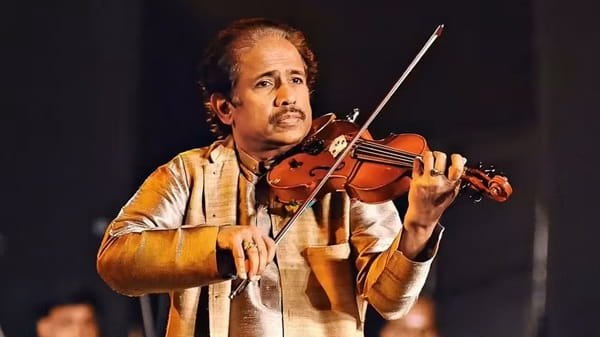
Dr. L. Subramaniam is one of the strongest global ambassadors of the Carnatic violin. Trained by his father, V. Lakshminarayana, he combines sharply articulated fingering with sweeping gamakas, fast briga-like passages and expansive bow control. His collaborations with Yehudi Menuhin, Stéphane Grappelli, George Duke and other international artists carried Indian violin far beyond the traditional concert platform.
Subramaniam received the Padma Shri in 1989 and Padma Bhushan in 2001. As composer, festival founder and performer, he helped establish the Indian violin as both a classical solo voice and a global concert instrument.
2. L. Shankar
Shankar, also known as Shenkar, is a Carnatic violinist, vocalist and major architect of Indo-jazz fusion. Trained in the Lakshminarayana family tradition, he co-founded Shakti with John McLaughlin, helping create a new language in which Carnatic raga and tala interacted naturally with jazz improvisation.
His most radical contribution is the 10-string stereophonic double violin, a double-necked electric instrument designed to cover the orchestral string range. His playing combines extreme speed, complex rhythmic phrasing and sustained melodic lines. His album Raga Aberi earned a Grammy nomination, while his cross-genre career became a model for later fusion violinists.
3. N. Rajam
Dr. N. Rajam changed the vocabulary of Hindustani violin. Trained first in Carnatic music by her father A. Narayana Iyer and later under Pandit Omkarnath Thakur, she developed the celebrated Gayaki Ang, making bowed phrases imitate the contours of khayal singing.
Her technique is built around seamless meend, vocal ornamentation, controlled bow pressure and exceptional intonation. Rajam received the Sangeet Natak Akademi Award in 1990, Akademi Fellowship in 2012, Padma Shri in 1984 and Padma Bhushan in 2004. In 2026, she was conferred the Padma Vibhushan, recognising a career spanning more than seven decades.
4. T. N. Krishnan
N. Krishnan was one of the celebrated “violin trinity” of Carnatic music, alongside Lalgudi Jayaraman and M. S. Gopalakrishnan. His playing was admired for tonal purity, restraint and immaculate bowing. He could shadow a vocalist with minute gamaka accuracy and then shape the same raga into a beautifully proportioned solo statement.
Krishnan learned from his father A. Narayana Iyer and became a benchmark of twentieth-century Carnatic classicism. He received the Padma Shri in 1973, Sangeet Natak Akademi Award in 1974 and Padma Bhushan in 1992.
5. Lalgudi Jayaraman
Lalgudi G. Jayaraman created one of the most identifiable violin languages in Carnatic music. Trained by his father V. R. Gopala Iyer in the Thyagaraja shishya-parampara, he developed the Lalgudi Bani: lyrical phrasing, compact bowing, precise gamakas and a vocal sensitivity that made every line feel sung.
He was equally distinguished as accompanist, soloist and composer, and his varnams and tillanas remain standard repertoire. Jayaraman received the Padma Shri in 1972, Sangeet Natak Akademi Award in 1978 and Padma Bhushan in 2001. His aesthetic continues through generations of disciples.
6. Kala Ramnath
Kala Ramnath is a major contemporary exponent of Hindustani violin and one of the clearest inheritors of the vocal-imitation ideal. From a distinguished violin family, she trained extensively with Pandit Jasraj, whose influence helped shape the lyrical approach associated with her “Singing Violin” style.
Ramnath uses sustained bowing, delicate meend and nuanced microtonal shading to reproduce the emotional inflection of a sung raga. She has worked with global ensembles including the Kronos Quartet and appeared on the Grammy-nominated Miles from India project. She received the Sangeet Natak Akademi Award in 2016.
7. Ganesh and Kumaresh
Brothers Ganesh Rajagopalan and Kumaresh Rajagopalan have performed together since childhood and developed one of Carnatic music’s most distinctive violin-duo formats. Trained by their father T. S. Rajagopalan, they combine rigorous raga grammar with rapid unison passages, contrapuntal exchanges, rhythmic improvisation and highly coordinated bowing.
Their concerts treat the violin as a complete lead instrument, with manodharma and tala interaction at the centre. The duo received the Kalaimamani award in 1997 and the Sangeet Natak Akademi Award jointly for 2018. Their long career has expanded the possibilities of two-violin performance.
8. Mysore Manjunath
Mysore Manjunath is a leading Carnatic soloist, educator and scholar whose technique is built on velocity without sacrificing pitch definition. Trained by his father S. Mahadevappa, he developed formidable left-hand agility, clean upper-register fingering and broad bowing that can move quickly between lyrical gamaka and high-speed swara passages.
He has collaborated with Indian and international musicians and orchestral projects while remaining firmly rooted in Carnatic music. Manjunath holds postgraduate and doctoral qualifications in music and has worked extensively as a teacher and lecturer. He received the Sangeet Natak Akademi Award in 2016.
9. Sunita Bhuyan
Sunita Bhuyan represents a different strand of Indian violin culture, linking Hindustani training with regional folk traditions and wellbeing work. She studied first with her mother, violinist Minoti Khaund, and later with Hindustani violin maestro Pandit V. G. Jog.
Her playing brings classical bow control and meend into Assamese melodic material, especially Bihu, while also exploring Celtic and world-folk collaborations. Her Bihu Strings project helped bring Assamese folk colour to a wider violin audience. She has also used music in programmes on wellbeing, inclusion and leadership, extending the instrument beyond the conventional recital stage.
10. Manoj George
Manoj George is a contemporary violinist, arranger and composer whose career sits at the intersection of Indian raga, orchestral writing, film music and global fusion. Rather than working only as a conventional classical soloist, he uses violin as a flexible lead and ensemble instrument across rock, blues, world music and cinematic scores.
George contributed as violinist, conductor and arranger to Grammy-winning projects including Winds of Samsara and Divine Tides. His own work combines Indian melodic ideas with Western harmony and amplified production. In 2026, he released Euphoric Pursuit, described by his team as India’s first violin-metal album.
Conclusion
These ten artists show how completely India has remade the violin in its own musical image. T. N. Krishnan and Lalgudi Jayaraman embodied Carnatic refinement; N. Rajam and Kala Ramnath made the instrument sing in the Hindustani idiom; L. Subramaniam and L. Shankar carried it onto global stages; and contemporary performers continue to stretch its sonic boundaries.
The future of Indian violin lies in preserving raga, tala, gamaka and meend while allowing new instruments, ensembles and technologies to emerge. Beyond 2026, that balance should keep the Indian violin deeply rooted, emotionally direct and globally relevant.