Few ornamental plants handle Indian heat as confidently as bougainvillea. Its papery bracts spill over compound walls, highway dividers, terraces, pergolas and balconies in colours ranging from white and yellow to orange, pink, purple and bicolour. Often called paper flower, bougainvillea is valued because it thrives in bright sun, tolerates drought and pollution, and can be trained as a climber, hedge, shrub, bonsai or container plant.
By 2026, Indian gardeners have far more choice than the common magenta roadside bougainvillea. ICAR-IARI maintains one of the country’s richest germplasm collections, while Indian breeding and selection have produced white, bicolour, multi-bracted, variegated and compact forms. Pusa Akansha adds a newer IARI option with variegated foliage, while classics such as Mary Palmer Special, Shubhra, Mahara and Thimma remain important for landscaping. Variety choice should consider colour, growth habit, thorniness, pot suitability and the space available. So, let’s check out the top 10 bougainvillea varieties in India!
1. Pusa Akansha
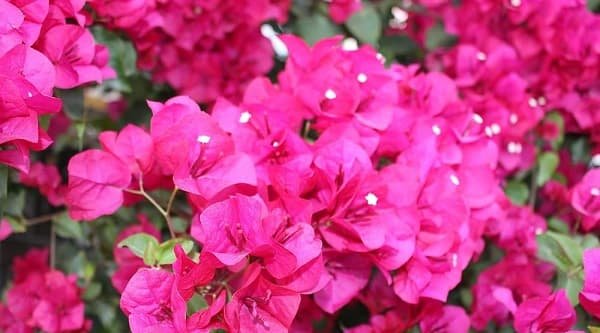
Pusa Akansha is the most current Indian bougainvillea on this list and gives the article a genuine 2026 angle. Developed at ICAR-IARI, it was released for Delhi-NCT and stands out because the foliage remains decorative even when the plant is between flowering flushes.
- Breeding status: A spontaneous mutant released by ICAR-IARI and highlighted in the institute’s recent floriculture portfolio.
- Foliage: Leaves have a yellowish-cream margin with a light-green centre, giving strong ornamental value throughout the year.
- Bract colour: IARI describes the bracts as light reddish-purple in the purple colour group.
- Best uses: Feature planting, large containers, terrace landscaping and sites where variegated foliage is as important as flowers.
2. Mary Palmer Special
Mary Palmer Special is one of India’s most famous bicolour bougainvilleas and a landmark in ornamental breeding. Its bracts combine white and magenta on the same cultivar, creating a dramatic two-tone display that looks especially striking on large structures.
- Bract colour: Distinctive white-and-magenta bicolour.
- Plant type: Popular single-bracted cultivar with vigorous landscape value.
- Best uses: Pergolas, arches, hedges, boundary walls and large containers.
- Special value: Its contrasting bracts make it one of the strongest choices where a single plant needs to create a multicolour effect.
3. Shubhra
Shubhra is the classic white Indian bougainvillea and one of the most important selections developed from Mary Palmer. It is prized for clean parchment-white bracts, profuse flowering and a hardy habit that made white bougainvillea far more practical for Indian gardens.
- Bract colour: Parchment white; ICAR literature lists it among the leading white cultivars.
- Flowering habit: Highly proliferous and known for profuse blooming.
- Best uses: Pots, beds, white-themed landscapes, walls and mixed-colour bougainvillea plantings.
- Garden value: The neutral white bracts contrast strongly with dark green foliage and brightly coloured companion cultivars.
4. Mahara
Mahara is a showy multi-bracted bougainvillea with a fuller, almost double-flowered appearance. Instead of the simple three-bract look of many cultivars, it produces dense clusters that give walls and pergolas a richer floral effect.
- Colour group: Listed by ICAR among the popular purple bougainvilleas.
- Bract type: Double or multi-bracted, producing dense ornamental clusters.
- Best uses: Pergolas, arches, large containers and prominent garden displays.
- Growth value: Its heavy bract clusters give more visual mass than many single-bracted types.
5. Thimma
Thimma is particularly attractive because its leaves contribute almost as much colour as its bracts. Indian horticultural references place it among pink-to-deep-pink cultivars and also identify it as a yellow-and-green variegated foliage type.
- Bract colour: Pink to deep pink.
- Foliage: Variegated yellow-and-green leaves create interest even outside peak bloom.
- Best uses: Potted displays, bonsai and decorative landscape planting.
- Special value: A strong choice for gardeners who want both colourful foliage and bougainvillea bracts on the same plant.
6. Partha
Partha is one of India’s most striking colour-changing bougainvilleas. Its bicolour bracts move from orange toward purple, making the plant appear to carry several shades at once as flowers develop and age.
- Bract colour: Bicolour, ranging from orange to purple.
- Plant type: Popular single-bracted Indian cultivar.
- Best uses: Pergolas, arches, fences and large garden structures.
- Display value: Excellent for gardeners who want changing warm-to-cool colour tones rather than one fixed bract colour.
7. Golden Glow
Golden Glow brings warm orange colour into bougainvillea collections dominated by pink and purple. The cultivar is well established in Indian germplasm lists and is particularly useful where a brighter golden-orange accent is needed.
- Bract colour: Orange to golden-orange.
- Growth role: Useful as a contrast plant beside white, purple or deep-magenta bougainvilleas.
- Best uses: Bonsai, pots, small landscape accents and mixed-colour planting schemes.
- Garden value: Its warm colour creates a distinctly different effect from the more common magenta roadside forms.
8. Pixie
Pixie is one of the most useful bougainvilleas for small urban spaces. Unlike vigorous climbers that quickly dominate walls and trees, Pixie has a miniature and compact habit, making it far easier to manage in balconies and smaller gardens.
- Bract colour: Pink to deep pink in Indian varietal classifications.
- Growth habit: Miniature and compact.
- Best uses: Containers, bonsai, balconies, terraces and compact ground-cover effects.
- Space advantage: A practical choice where gardeners want bougainvillea colour without a large climbing framework.
9. Lady Mary Baring
Lady Mary Baring is valued for something comparatively uncommon in bougainvillea collections: yellow bracts. The softer colour works well in formal landscapes and provides a bright but less intense alternative to magenta, red and purple.
- Bract colour:
- Landscape role: Useful for colour contrast in mixed bougainvillea borders and multicolour grafted displays.
- Best uses: Pots, specimen plants and bright sunny garden locations.
- Design value: Pairs particularly well with purple, white or deep-pink cultivars for high-contrast landscaping.
10. Dr H.B. Singh
Dr H.B. Singh is a recognised Indian bougainvillea cultivar that remains important because of its versatile growth and container value. Indian horticultural recommendations specifically list it for potted plants and hanging baskets, making it more flexible than many very vigorous climbers.
- Indian status: Part of the nationally documented bougainvillea germplasm maintained and characterised by Indian research institutions.
- Growth habit: A cultivar with useful ornamental branching and display potential.
- Best uses: Potted bougainvillea and hanging-basket displays.
- Landscape value: Well suited to gardeners who want a named Indian cultivar for controlled ornamental use rather than a large wall-covering vine.
Practical Grower’s Guide: How to Choose & Maintain Bougainvillea
- Give it full sun: Bougainvillea flowers best in strong sunlight. Shade encourages leafy growth and reduces the colourful bract display.
- Avoid constantly wet soil: Use a fast-draining medium and allow the root zone to dry somewhat between irrigations. Waterlogging encourages weak growth and root problems.
- Do not overfeed nitrogen: Too much nitrogen produces long green shoots at the expense of flowering. Balanced feeding and controlled watering are more useful.
- Prune after a flowering flush: Bougainvillea blooms on new growth. Pruning and pinching after flowering encourage fresh shoots and help maintain the desired shape.
- Match vigour to space: Use Pixie and potted cultivars for small areas; vigorous types such as Mary Palmer Special, Mahara and Partha are better for pergolas, walls and large structures.
Conclusion
India has one of the world’s richest bougainvillea collections, and the best variety depends on how the plant will be used. Pusa Akansha adds modern variegated foliage, Mary Palmer Special and Partha bring bicolour effects, Shubhra supplies clean white, while Mahara creates dense multi-bracted displays. Pixie and Dr H.B. Singh suit controlled spaces, whereas vigorous varieties are better for walls and pergolas. With full sun, restrained watering and timely pruning, bougainvillea can remain one of the most rewarding ornamentals for Indian landscapes.
Frequently Asked Questions
Q. Which bougainvillea variety is best for pots?
Pixie is one of the best compact choices. Indian horticultural recommendations also list Shubhra, Thimma, Mahara, Mary Palmer and Dr H.B. Singh for potted bougainvillea.
Q. Which bougainvillea variety has white flowers?
Shubhra is one of India’s best-known white cultivars and is valued for profuse parchment-white bracts. Dr B.P. Pal, Snow Queen and Snow White are other recognised white types.
Q. Which bougainvillea variety is best for a pergola or arch?
Mahara, Partha and Mary Palmer are specifically recommended for pergolas and arches because their growth habit and heavy bract display suit larger structures.
Q. Which newer Indian bougainvillea variety is important in 2026?
Pusa Akansha is the standout newer IARI release. Its variegated yellowish-cream and green foliage gives it year-round ornamental value in addition to its coloured bracts.